
QE and Concrete: Can Public Housebuilding Reboot the Economy?
26th March 2026
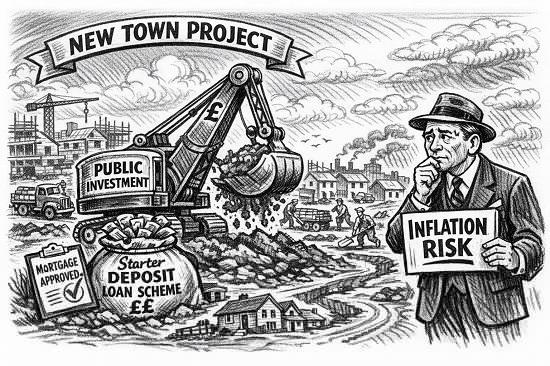
Lessons from the Post-War house building Boom
Between 1951 and 1964, successive UK governments pledged and delivered 300,000–400,000 new homes per year. This included New towns like Glenrothes, East Kilbride, and Cumbernauld.
Mass council housing in cities and rural areas
High public investment, often coordinated by local authorities
Direct job creation in construction, materials, transport, and planning
This was a deliberate Keynesian strategy: stimulate demand, reduce unemployment, and rebuild post-war Britain. It worked—at least temporarily.
But by the late 1950s, the Treasury and Bank of England began covertly restricting housebuilding as part of “stop-go” macroeconomic policy. They feared inflation, currency weakness, and over-reliance on credit. Mortgage availability was squeezed, and building society funds were starved.
Could QE-Funded Housebuilding Work Today?
Quantative Easing (QE) funding via Bank of England Cheap capital for public investment - Inflation if supply chains are tight
Mass housebuilding -Jobs, housing, economic stimulus Land use conflicts, planning delays
Tax returns from new activity - VAT, income tax, council tax
Lag between spend and tax recovery
Targeted regional investment
Revives fragile areas like Caithness and Sutherland Needs coordination with local authorities
The Resolution Foundation and others warn that credit-based schemes without supply reform (like Help to Buy) simply push up prices. A QE-funded build programme must be paired with:
Planning reform to unlock land
Skills investment to expand the workforce
Local authority empowerment to deliver housing where it’s needed
Rent controls or price caps to prevent speculative inflation
Would Inflation Be a Necessary Evil?
Possibly. If inflation rises due to productive investment—not speculation—it may be tolerable. The key is ensuring:
The inflation is temporary and contained
The benefits (jobs, homes, tax revenue) outweigh the costs
The Bank of England coordinates with fiscal policy, not fights it
This is where post-war lessons matter. Britain’s 1950s boom was undone by stop-go cycles, where stimulus was followed by deflation. A modern programme must be consistent, long-term, and locally grounded.
Bottom Line for Scotland
In places like Aberdeen, Caithness, and the Highlands, a public housebuilding surge could:
Create anchor employment
Stabilise fragile communities
Reduce housing stress for young families
Stimulate local economies
But it must be planned, not just funded. QE alone won’t build houses. Only coordinated public action will.