
Can Scottish Businesses Survive the Energy Shock and Policy Pile‑On?
4th April 2026
Why the next year will test the resilience of Scotland’s local economy especially north of Perth
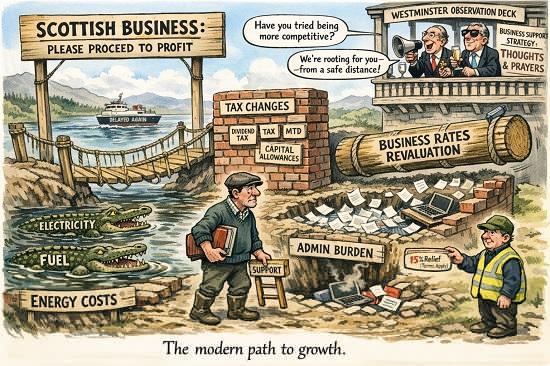
If you want to understand the pressure Scottish businesses are under, picture a crofter trying to mend a fence in a gale. Every time he hammers one post in, another one blows over. That’s what 2026 feels like for small firms across Scotland. Energy prices are rising again, tax rules are shifting, business‑rates relief is tightening, and Making Tax Digital is about to swallow every spare hour of admin time. It’s not one big crisis — it’s a slow‑motion squeeze from every direction.
The energy shock alone would be enough to rattle the system. Electricity and fuel costs feed into everything: heating a workshop, running a van, keeping a café open on a cold Tuesday in February. In the Highlands and Islands, where distances are long and margins thin, energy isn’t a line on a spreadsheet. It’s the difference between staying open and quietly shutting the door for good.
Layer on top of that the UK‑wide changes: slower capital allowances, higher dividend tax, tighter reliefs on business assets, and the looming quarterly reporting burden of Making Tax Digital. Owner‑managers who once used dividends to cushion shocks now find that cushion noticeably thinner. And while the Scottish Government has tweaked business rates to soften the revaluation blow, the reliefs are patchy. 15% for most hospitality and retail, 100% only in islands and a few remote pockets. For a pub in Wick or a shop in Dingwall, that’s helpful but it doesn’t magic away the rising cost of energy, stock, transport, and compliance.
The businesses most at risk are the ones that form the backbone of rural Scotland: bakers, garages, small manufacturers, cafés, trades, and family‑run shops. These are not firms with deep reserves or corporate buffers. They’re run by people who know every customer by name and every bill by heart. When energy spikes and tax rules tighten at the same time, there’s no slack in the system.
And yet, Scottish businesses have a habit of surviving storms that would flatten others. They adapt, trim, improvise, and keep going long after logic says they shouldn’t. But resilience has its limits. The danger now is not a dramatic wave of closures — it’s a slow erosion. A workshop that stops taking apprentices. A café that cuts winter hours. A shop that quietly closes on Mondays. A haulage firm that sells one of its lorries and never replaces it. The kind of attrition that hollows out local economies without ever making headlines.
Can Scottish businesses survive? Many will. But the cost of survival will be felt in reduced capacity, higher prices, and a gradual thinning of the local economic fabric. The real question isn’t whether they can endure it’s how much we lose in the process.