
Scotland’s Cost‑of‑Living Crunch: Why Energy and Policy Shocks Hit Harder North of the Central Belt
4th April 2026
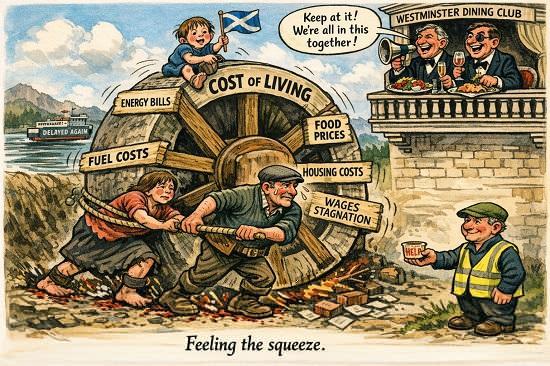
When businesses struggle, households pay — and rural Scotland pays twice.
If you want to see how national policy changes land in Scotland, especially in the Highlands, don’t look at the legislation look at the weekly shop, the fuel gauge, and the heating bill. That’s where the impact shows up first. And in 2026, the cost‑of‑living story is being written not by one big crisis, but by a series of overlapping pressures that all push in the same direction.
Start with energy. When electricity and fuel prices rise, Scottish households feel it more sharply than most of the UK. Not because Scots use more energy, but because the geography demands it. Long commutes, cold winters, older housing stock, and limited public transport mean energy is not optional — it’s structural. A family in Caithness or Skye can’t simply “drive less” or “take the bus.” The bus may not exist, and the nearest supermarket might be 20 miles away.
Then look at what’s happening to businesses. When small firms face higher energy bills, tighter tax rules, and more admin, they don’t absorb the cost — they pass it on. A bakery raises prices. A garage charges more for repairs. A café increases the cost of a coffee. A tradesperson adds a fuel surcharge. These aren’t greedy decisions; they’re survival decisions. But they land directly in household budgets.
In rural Scotland, the effect compounds. When a business closes or cuts hours, people travel further for the same services which means more fuel, more time, and more cost. A closed shop in Wick or Brora isn’t replaced by another shop round the corner. It’s replaced by a many miles round trip to Inverness. That’s how the cost of living rises even when inflation falls: the infrastructure thins out, and the cost of distance grows.
Meanwhile, wages in many rural sectors such as hospitality, retail, care, trades simply can’t keep pace with rising costs. Businesses can’t raise pay when their own margins are being squeezed from every direction. So households face the worst combination: higher bills, higher prices, and stagnant incomes.
The result is a uniquely Scottish version of the cost‑of‑living crisis. Not the dramatic spikes of 2022, but a grinding, structural pressure that makes life steadily more expensive in ways that don’t show up neatly in national statistics. It’s the cost of distance, the cost of cold, the cost of thin markets, and the cost of policies designed for places with trains, trams, and supermarkets on every corner.
Scotland especially rural Scotland isn’t just dealing with higher prices. It’s dealing with a system that amplifies every shock. And unless energy, transport, and local economic resilience are treated as core national priorities rather than regional footnotes, the gap between Scotland’s lived reality and Westminster’s assumptions will only widen.